How Many Syrup Pouches a Month? A Cafe Inventory Guide
October 30, 2026
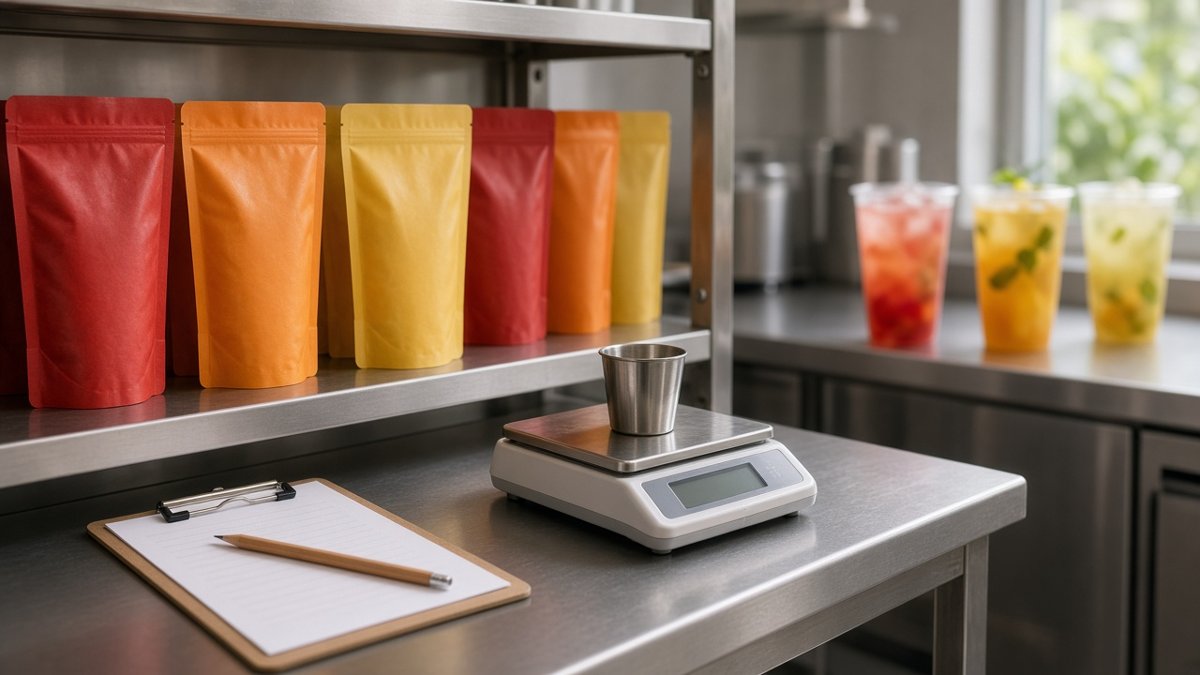
Running out of strawberry syrup on a Saturday afternoon costs more than one sale. It costs every strawberry drink until the next delivery, and the regulars who quietly try somewhere else.
The short answer: weigh one standard pour, multiply by the cups you sell each week, and divide by 2,000 grams for a 2kg pouch. That gives you pouches per week for each flavor. Multiply by four for a month, add a buffer, and you have an order you can trust instead of a guess.
How much syrup goes into each drink?
Every inventory number starts with the pour. The 16 oz builds below follow the ratios on our recipe pages. The 24 oz column is a starting point to test in your own cups, since ice and cup shape change the result.
Fruit milk tea
16 oz: 1.5 oz syrup, 10 oz brewed tea, splash of milk or creamer, ice
24 oz: start at 2.25 oz syrup, 15 oz brewed tea, milk or creamer, ice
Fruit latte (iced)
16 oz: 1.5 oz syrup, 8 oz milk, ice
24 oz: start at 2.25 oz syrup, 12 oz milk, ice
Fruit ade
16 oz: 3 oz syrup, ice, top with sparkling water
24 oz: start at 4 oz syrup, ice, top with sparkling water
Notice that an ade uses about twice the syrup of a milk tea. If ades are your best sellers in summer, your syrup use can jump even when total cup count stays flat. That is why you count by drink, not just by cups.
Why should you count syrup in grams, not ounces?
Because the pouch is sold by weight. Fruit syrup is denser than water, so a 1.5 fluid ounce pour weighs more than 1.5 ounces on a scale. Put a cup on a kitchen scale, zero it, and pour one serving with the tool your staff actually use, whether that is a marked squeeze bottle, a jigger or a 3 oz scoop. Do it three times and average it. Write down grams per pour for each drink and size.
How do you calculate pouches per week?
Use this line for each flavor:
Pouches per week = (grams per pour x drinks per week) / 2,000
Here is an example with made-up numbers, just to show the math. Say one strawberry milk tea pour weighs 55 g and you sell 300 strawberry milk teas a week. That is 16,500 g, or 8.25 pouches. Add 60 strawberry ades at 110 g each, another 6,600 g, and the flavor needs about 11.6 pouches a week. Round up to 12.
Pull drink counts from your POS for the last four weeks, not just last week. One rainy week or one big catering order can throw off a single snapshot.
What is a par level, and how do you set one?
A par level is the number of pouches you want on the shelf right after a delivery arrives. A simple way to set it:
Par level = weekly use x weeks between orders + safety stock
If you order every two weeks and use 12 strawberry pouches a week, your base is 24. Safety stock covers a busy weekend, a promo that takes off, or a delivery that arrives a day late. Many shops start with about half a week of use as safety stock, then adjust after a month of real counts. In the example, that would mean a par of 30 pouches.
When should you reorder?
Reorder when the shelf count drops to your reorder point, not when someone notices it looks low. The reorder point is the use you expect between placing an order and receiving it, plus your safety stock. Ask your supplier how long delivery takes to your area, and use that number. For large or pallet orders, timing depends on the order, so confirm it before you plan around it.
Make the count part of a routine. A quick shelf count on the same day each week, written on a sheet taped inside the storage room, beats any memory.
How do you handle slow and seasonal flavors?
Slow movers need a different rule. If a flavor uses one pouch every two weeks, keeping five on the shelf ties up cash and storage space. Keep one open and one sealed, and reorder when you open the sealed one.
Seasonal drinks need a plan before launch. Look at the drink's expected share of sales, set a starting par for the first two weeks, then recount after week one. It is easier to place a second order than to sit on extra pouches after the season ends.
How should you store and rotate pouches?
Store sealed pouches in a cool, dry spot away from the fryer, dishwasher and direct sun. Refrigerate after opening, and follow the storage directions on the pack. Check the best-by date printed on every pouch when a delivery arrives, then rotate first in, first out: new stock goes behind, older stock goes in front. Label opened pouches with the date they were opened so the next shift knows which to use first.
Rotation matters more when you buy in bulk. A case or a pallet saves on reorders, but only if the oldest stock gets used first.
What does buying by the case or pallet change?
A 2kg pouch is easier to portion and store than many large containers, and buying by the case or pallet means fewer orders to place each month. Umma's Recipe, for example, packs its real fruit syrups in 2kg pouches with no artificial flavors or colors, and ships nationwide from New Jersey with pallet shipping available. Whichever supplier you use, ask about case counts, delivery timing to your area and how best-by dates are printed, then plug those answers into your par levels.
Frequently asked questions
How many drinks does one 2kg pouch make?
Divide 2,000 by your grams per pour. A heavier pour, like an ade, gives fewer drinks per pouch than a milk tea, so calculate it for each drink.
How often should we count syrup inventory?
Once a week works for most cafes. Busy shops or shops running a seasonal launch may want to count twice a week.
Should every flavor have the same par level?
No. Set par by each flavor's actual weekly use. Your top two flavors often need most of the shelf space.
What if we run out between orders?
Raise the safety stock for that flavor and check whether a promo or menu change raised its use. Recount for two weeks before changing it again.
How do we get bulk pricing and delivery timing?
Bulk pricing and timing depend on the order, so contact the supplier directly for a quote.
Get a bulk quote or request free samples at ummasrecipe.com/wholesale.