How to Read a Fruit Syrup Label (and Spot Real Fruit)
June 27, 2026
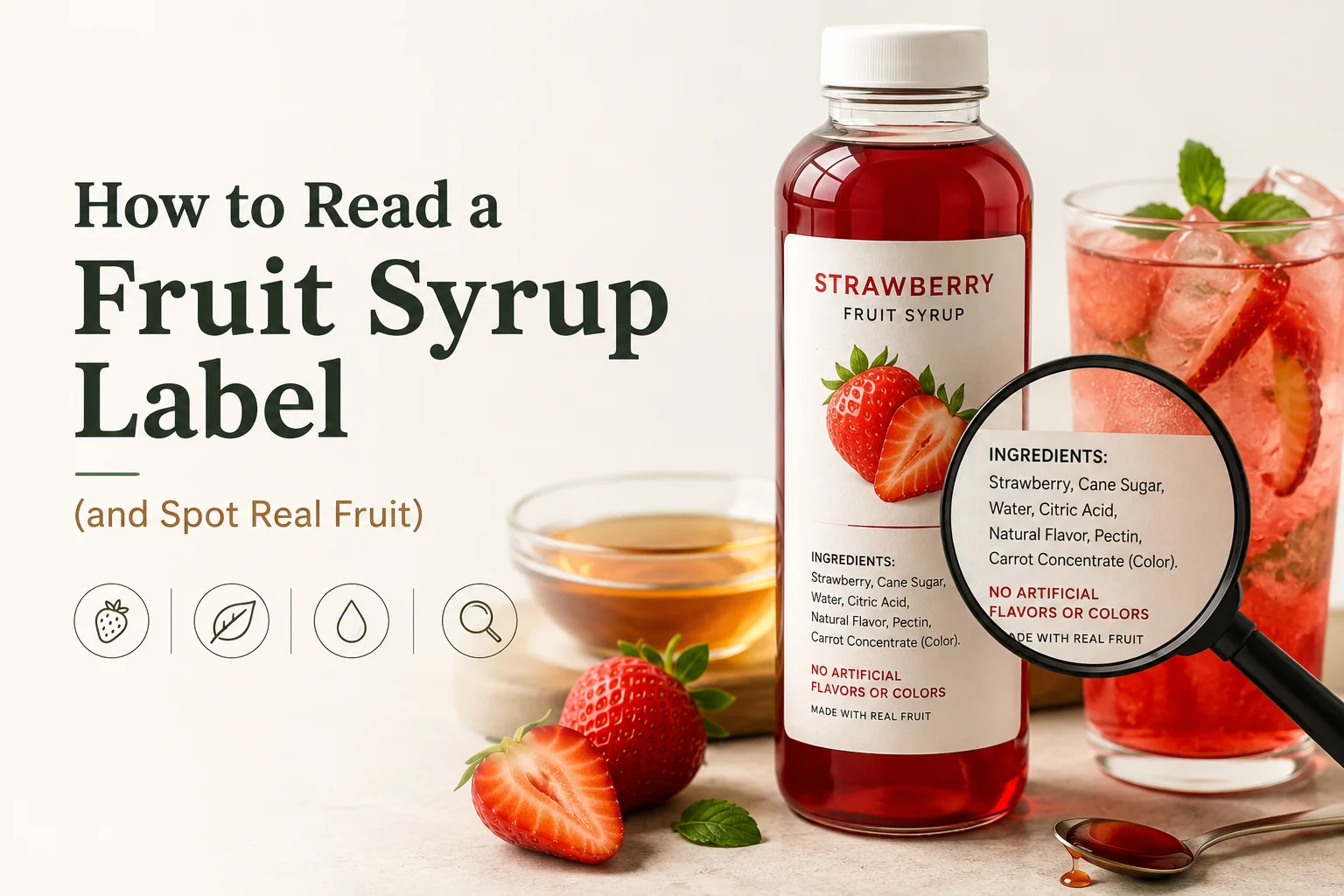
Front labels are marketing. The ingredient list is the truth. If you're choosing a fruit syrup for a café, bar, or boba shop and authenticity matters, learning to read the back of the bottle is the single most useful skill you can have. Here's how to do it in about thirty seconds.
Step 1: Look for the fruit by name
This is the big one. A real-fruit syrup lists the fruit — "strawberry," "mango," "peach" — as an ingredient. A flavoring syrup lists "natural flavor" or "natural and artificial flavors" and a color, but no fruit at all. Two bottles can both say "Strawberry Syrup" on the front; only one names strawberry on the back.
If the fruit isn't in the ingredients, the bottle isn't made with fruit — it's flavored to taste like it. That's not illegal or even unusual; it's just a different product, and it's the line that separates "real fruit" from "flavoring."
Step 2: Check the flavor source
Look for how the flavor is described. "No artificial flavors" backed up by natural flavor (and real fruit) is what you want. "Artificial flavor" or "natural and artificial flavors" tells you a lab compound is doing some of the work.
Step 3: Check the color source
Natural color comes from the fruit itself or from ingredients like fruit and vegetable juice, beta-carotene, or turmeric. Artificial color shows up as names like FD&C Red 40, Yellow 5, or Yellow 6. A neon, perfectly uniform shade is often the tell. If a label says "no artificial colors," the ingredient list should confirm it — no FD&C dyes.
What doesn't actually matter as much as you'd think
A couple of things commonly get flagged as "bad" that usually aren't the real dividing line:
Preservatives. Many quality, shelf-stable syrups use a small amount of a preservative to stay safe and consistent over a long shelf life. On its own, that's normal and not a red flag — it's how a bottle survives months in your stockroom. The thing to focus on is whether the fruit is real and the flavors and colors are natural, not whether a preservative exists at all.
Sugar. A syrup is a sweetened concentrate by definition — that's what makes it pourable, shelf-stable, and able to carry flavor in a small amount. The useful question isn't "is there sugar," it's "where does the flavor come from" — real fruit, or a flavor compound.
Other ingredients you'll commonly see (and what they do)
Pectin, modified food starch, xanthan or guar gum: thicken and stabilize the syrup. Normal.
Citric or malic acid: balance sweetness and brighten flavor. Normal.
Glycerin: helps texture and shelf stability. Normal.
These aren't warning signs — they're standard tools for making a stable, pourable syrup.
The 30-second label test
Is the fruit named in the ingredients? (Real fruit vs. flavoring.)
Does it say no artificial flavors — and does the list back that up?
Does it say no artificial colors — and are there no FD&C dyes?
Where is it made, and will the supplier tell you plainly?
If a syrup passes the first three and a supplier answers the fourth without hedging, you've found a real-fruit syrup you can put on your menu with confidence.
Why this matters for your menu
Customers are reading labels now, and "made with real fruit, no artificial flavors or colors" is a claim you can only make if the bottle backs it up. Reading the label before you buy protects your menu's credibility — and helps you avoid paying a premium for what's really just flavored sugar water.
About Umma's Recipe
Umma's Recipe makes real-fruit syrup with the fruit named right on the ingredient list — made with real fruit, with no artificial flavors or colors, produced in Korea in an FDA-registered facility. Read our labels, compare them to whatever you pour now, and see the difference for yourself. The links below take you to the lineup and wholesale program.