Fruit Syrup vs. Real Juice for Bubble Tea: How to Choose for Your Boba Menu
June 26, 2026
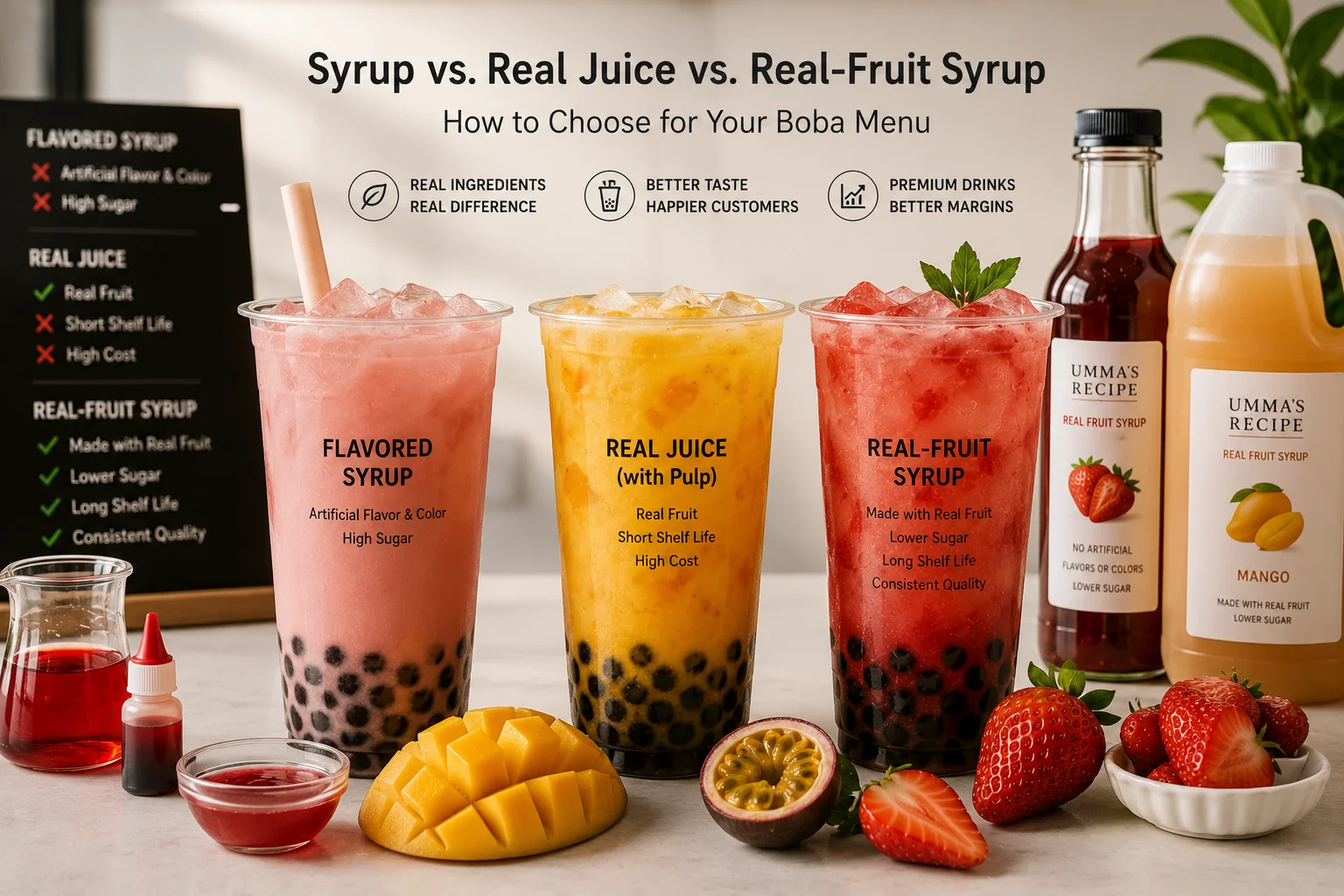
In a clear cup, your ingredients are on display. That's the thing that makes bubble tea different from almost every other drink category: customers can literally see whether your fruit is real. So the choice of what you build your fruit drinks with — flavored syrup, real juice, or real-fruit syrup — isn't just a back-of-house decision. It's a menu-differentiation lever your customers can taste and see.
Here's how the three options actually compare for a boba menu.
Flavored syrup
The classic option. A sugar-based concentrate carrying flavor (sometimes natural, often artificial) and color. It's cheap, intensely consistent, and shelf-stable, which is why it's everywhere. The catch is authenticity: experienced boba customers can tell when "mango" is really a flavor compound and a dye. As more drinkers check labels and look for "real fruit," a fully artificial syrup quietly caps how premium your menu can feel.
Real juice (and juice with pulp)
The authenticity play. Real juice — especially with visible pulp — signals quality through the cup and supports a noticeably higher menu price for signature drinks. The trade-off is operational: real juice typically costs significantly more per serving, has a much shorter open shelf life, and creates more waste and labor. For premium, social-media-worthy signature drinks it can be worth it; for an everyday value-tier menu it's hard to run efficiently.
Real-fruit syrup
The practical middle — and, for most menus, the sweet spot. A real-fruit syrup is made from actual fruit, so it delivers genuine fruit flavor and a natural color, but it keeps the operational advantages of a syrup: shelf-stable, consistent batch to batch, low waste, and fast to pour during a rush. A good real-fruit syrup also fits the clean-label, real-fruit direction boba customers are moving toward. You get the "real fruit" story your customers are paying attention to, without the spoilage and labor of working with fresh juice across a full menu.
Why "real fruit" matters more in boba than almost anywhere
The data backs up what the clear cup already tells you. As more drinkers check ingredient labels and look for "real fruit," that claim has become both a flavor upgrade and a pricing upgrade — and in a category built on visual appeal and Instagram moments, "made with real fruit" is exactly the kind of signal customers notice.
What actually matters operationally
When you choose, weigh the things that make or break a boba program:
Throughput. Can your team build the drink fast and the same way every time during peak hours?
Consistency. Does every cup taste identical across staff and shifts? Syrups win here; fresh juice varies.
Shelf life and waste. Shelf-stable real-fruit syrup means far less spoilage than open juice.
Pricing power. Can you tell — and prove — a "real fruit" story that supports a premium price?
Menu fit. Many shops use real-fruit syrup as the backbone of the menu and reserve fresh juice with pulp for a few high-end signature drinks.
How to choose for your menu
Think in tiers. For your core, high-volume fruit drinks — fruit teas, slushes, smoothies, and refreshers — a real-fruit syrup gives you authentic flavor, speed, and consistency at a sustainable cost. For a small number of premium signature drinks, layering in real juice with pulp can add visible texture and justify a top-tier price. Building the menu this way lets you tell a genuine "real fruit" story across the board while keeping the kitchen efficient.
The bottom line
Your boba customers can see and taste the difference between real fruit and artificial flavoring — and they're increasingly willing to pay for the real thing. A real-fruit syrup lets you put that difference in every cup without the spoilage and labor of fresh juice, which is why it's the practical foundation for a premium, profitable boba menu.